YoutubeCelebrity.TV

Celebrity Media Alliance

Six UN Languages News.

منصة وسائل الإعلام المشاهير تبث الأخبار يوم الاثنين باللغة العربية

名人媒体平台星期二使用中文播报新闻

The celebrity media platform broadcasts news on Wednesday in English

La plateforme médiatique des célébrités diffuse les nouvelles le jeudi en français

Медийная платформа знаменитостей вещает новости в пятницу на русском языке

La plataforma de medios de celebridades transmite noticias el sábado en español

Strong UN Better World! 联合国强大 世界更美好!


Celebrity Media Multi-Channel News Broadcast
六语言版本 Six Languages
News Summary of the Election for the Tenth Secretary-General of the UN

English Media

Celebrity Media Journalist Commentary: Pioneer of the Multilingual News System — The Innovative Path of International Communication by the Celebrity Media Foundation

In the era where artificial intelligence is reshaping the landscape of communication, the power of language has been redefined. It is no longer merely a medium of communication but an essential bridge for cultural exchange, value resonance, and global consensus. In this historical process, the Celebrity Media Foundation, under the operation and management of the Foundation Network AI Technology Department, has been at the forefront of international journalism with its innovative technological system and multilingual communication philosophy. It has become an important pioneer in the multilingual and international practice of news in the AI era.

I. Six-Language Parallel Communication Framework: Let the world hear six voices at the same time. The Celebrity Media Foundation, with the core concept of “Six-Language Integration and Cross-Border Communication,” has built a global multilingual news network.
The foundation operates at least three major platforms: Celebrity Media International, Celebrity Media Alliance, and YouTube CelebrityTV. These platforms primarily publish in the six official languages of the United Nations (Arabic, Chinese, English, French, Russian, and Spanish), forming a unified and interconnected matrix of international reporting.

The foundation pioneered the concepts of the “Six-Language News on One Page Model” and the “Independent Language-Switching Player.” Viewers can freely switch between language versions on the same page, achieving a “Global Synchronization and Six-Language Integration” communication effect. This technological breakthrough not only improves the efficiency of international news dissemination but also realizes true linguistic equality in form, allowing audiences from different language regions to share the same news event and story simultaneously.

Player loading...

The UN Secretary-General and the President of the UN General Assembly rang the Peace Bell on the occasion of the 80th anniversary of the United Nations.

The profound significance of this innovation lies in transforming international communication concepts — from monolingual output to multilingual coexistence, and from “information dissemination” to “cultural dialogue.”

II. AI and Human Collaboration: The Driving Engine of News Production. Facing the transformation needs of journalism in the AI era, the Celebrity Media Foundation pioneered the “AI + Human Integrated Production System.”
By leveraging AI translation, speech synthesis, and multimodal algorithms, the foundation can generate six language versions of the same content in a very short time. Based on this, a professional editorial team performs cultural proofreading and content refinement to ensure linguistic accuracy and journalistic professionalism.

This model of “Machine Speed + Human Quality” creates a new balance between speed and depth in news production. As a result, the Celebrity Media Foundation has become one of the few non-governmental and non-profit international media institutions in the world capable of continuously producing six-language synchronized reports.

Meanwhile, to align with the AI-era trend of “Everyone Is Media,” the foundation launched a “Mobile News Rapid Publishing Service.” Users can submit multimedia news content, including text, photos, or videos, via their mobile phones without geographic limitations. The editorial team then publishes bilingual (Chinese-English) versions and provides both landscape and portrait video formats.
Whether viewed on a computer or a mobile device, in landscape or portrait mode, the browsing experience remains excellent and impressive.

More distinctively, what ordinary platforms lack is that the Celebrity Media Network possesses a “Long-Term Recall and Homepage Re-Display Feature.” Previous reports can be brought back to the homepage anytime for review, without the need to search. This innovative model of “time retraceability and continuous content renewal” extends the life of news and provides a new paradigm for multilingual news preservation and redistribution.

III. Cross-Sector Collaboration: Giving Voice to UN Agendas. Over the years, the Celebrity Media Foundation, with its professional international reporting capability, has become an important representative in the field of non-governmental media. Its journalists have been invited many times to cover major international conferences and events, delivering the voices of world leaders and UN officials globally through six-language video reports.

The topics covered by Celebrity Media include Sustainable Development Goals (SDGs), Climate Change, AI Governance, and International Peace and Development. This series of reports not only demonstrates the foundation’s professionalism in global agenda communication but also reflects its consistent support for and alignment with the mission and values of the United Nations.

Within the international public opinion system, the foundation’s multilingual reporting has been repeatedly listed on international media platforms’ “Special Media Lists” and invited to major institutional events, becoming a globally recognized platform for international expression.

IV. Public Welfare and Culture Together: The Social Dimension of Media Innovation.

In addition to international news reporting, the foundation actively promotes public welfare and cultural exchange, forming a “Media + Public Welfare + Education” integrated service framework.
Main initiatives include:

  • Funding and supporting UN public welfare and international affairs projects;
  • Reporting on science, culture, and art events to enhance public awareness of global affairs;
  • Organizing seminars and training programs with experts, scholars, and UN personnel to share experiences and knowledge;
  • Co-producing film, television, and cultural events to provide practical support for communities and youth.

These initiatives not only enrich the cultural lives of the public but also spiritually unite society around the shared pursuit of peace and sustainable development.

V. Commentary: A New Model for International Discourse in Non-Governmental Media. As the global media landscape continues to evolve, the Celebrity Media Foundation, through its six-language simultaneous news model, AI-driven production system, and cross-platform publishing matrix, has charted an independent and open path for international communication. It breaks the boundaries of traditional monolingual communication and establishes a multilingual news system with both academic and practical significance.

This represents a comprehensive upgrade from technological innovation to communication philosophy: from speed to warmth, from linguistic equality to cultural trust, from “reporting the world” to “connecting the world.” The foundation’s exploration showcases the potential of non-governmental media in contributing to global discourse and provides a replicable model for the multilingual development of future international journalism.

In conclusion, amid the explosion of information and linguistic fragmentation, the Celebrity Media Foundation responds to the times with the concept of “Multilingual Integration” and reshapes communication practices through the “AI + Human” model. This is not only a technological breakthrough but also a cultural awakening — enabling every language to become a vessel for understanding and peace, allowing global audiences to share one world across different linguistic contexts.

— Reported by Celebrity Media Journalist Wen Ping

Soundcloud AUDIO: Secretary-General Guterres' address to the Security Council.

A UN peacekeeper rescues a child after parts of the capital of Haiti, Port-au-Prince were flooded during a tropical storm in 2007.UN Photo/Marco Dormino A UN peacekeeper rescues a child after parts of the capital of Haiti, Port-au-Prince were flooded during a tropical storm in 2007.

By Vibhu Mishra

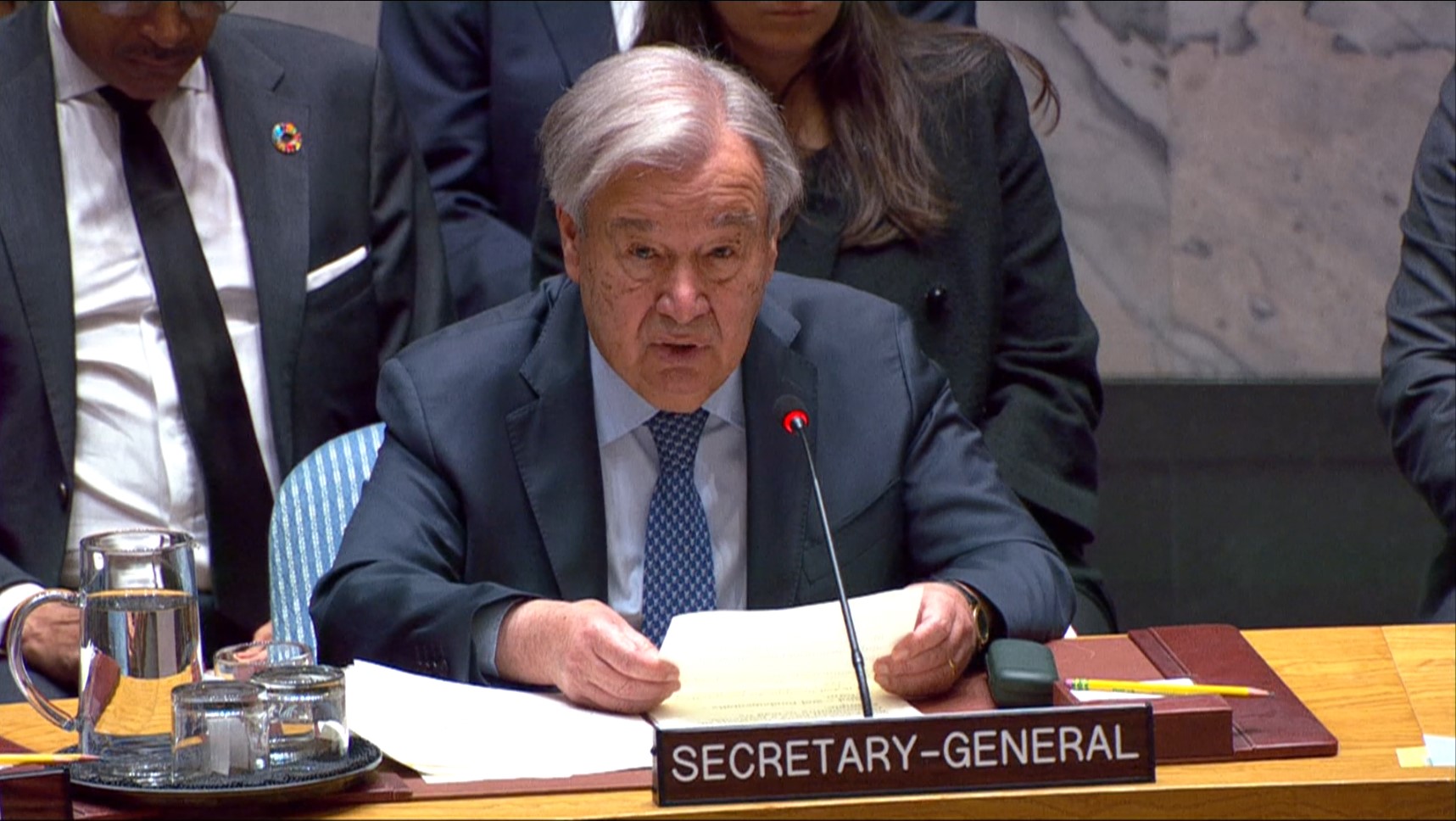
Secretary-General António Guterres on Friday warned that the “fragile” legitimacy of the Security Council could endanger global peace if it remains gridlocked and fails to fulfil its primary purpose.

Mr. Guterres was addressing ambassadors in the iconic chamber in New York on United Nations Day, marking 80 years since its founding. He spoke via video link from the capital of Viet Nam, Hanoi, during a robust open debate on how the UN navigates an uncertain future.


As the UN’s primary body for maintaining international peace and security, the council wields significant power, including the authority to impose sanctions and authorize military action.

Five of its 15 members have a permanent seat and were granted veto power under the UN Charter.

While the Council has played a central role in peacekeeping, conflict resolution and upholding international law, its veto system has often stalled action and sparked criticism.

The body’s structure is viewed by many countries and top officials as unrepresentative, leaving regions like Africa and Latin America without a permanent voice.

Invoking those who have looked to the council over 80 years to end wars, Mr. Guterres said that “the privilege to sit at this table carries a duty – above all – to honour the faith of those people,” he said. “Without a Security Council fit for purpose, the world is in grave danger.”

Debate over fundamentals

Presiding over the council for October, Russia praised the UN’s achievements but criticised the actions of Western governments, while elected (non-permanent) member Guyana, said the body was unrepresentative, advocating for greater and meaningful global representation.

The United States focused on operational reform, accountability, and called for a merit-based selection of the next Secretary-General – who takes the helm in January 2027 – emphasising the primacy of national sovereignty and transparency in the selection process.

The US representative called for an end to a selection process based on regions taking it in turns, arguing it was time to choose from a global roster of candidates.

Secretary-General António Guterres (on screen) addresses Security Council members.
UN Photo/Manuel Elías
 
Secretary-General António Guterres (on screen) addresses Security Council members.
 
A UN for the weak, not the powerful

The UN chief painted a vivid picture of how Council decisions can impact citizens worldwide:

The Security Council is not about hegemons and empires. It is about parents who have lost their children, refugees flung far from their homes, soldiers who have sacrificed their limbs.

In every shadow of this Chamber, you are surrounded by the ghosts of the dead. But beside them stands something else – the hopes of the living.

He urged Council members to listen to those hopes.

“Listen closely and you will hear the cries of your citizens who rally for peace; the whispers of families who long for safety...The United Nations emblem does not bear the laurel wreath of a victor, but the olive crown of a peacemaker.

But its legitimacy is fragile

Mr. Guterres highlighted the Council’s successes over eight decades, from helping Cambodia emerge from genocide to supporting South Africa’s transition from apartheid and deploying missions in Sierra Leone, Timor-Leste, and Liberia.

Yet its legitimacy remains fragile, he stressed, noting that violations of the UN Charter by some Member States erode trust and risk global stability.

He called for and expanded membership to better reflect the world’s demographics, including permanent representation for Africa, Latin America and the Caribbean.

Mr. Guterres also encouraged discussions on proposals to limit the use of the veto.

A wide view of the Security Council as Secretary-General António Guterres (on screen) addresses members.
UN Photo/Manuel Elías A wide view of the Security Council as Secretary-General António Guterres (on screen) addresses members.
 
Russia: Divisive Western powers

Russia’s Ambassador Vassily Nebenzia praised the UN’s achievements but cautioned against the actions of Western powers.

“In an effort to maintain its waning influence, the West divided the world into ‘us’ and ‘them’ – ‘democracies’ and ‘autocracies’ – a group of those who are chosen, and those who are violating their imposed order,” he said.

As a result, many of the UN Charter’s principles remain concepts, not a reality. “Adventures” – from the Iraq invasion and Colour Revolutions to the recent invasion of Iran – have only led to tragedy, he said.

Guyana: Reform now

Guyana’s Ambassador Carolyn Rodrigues-Birkett echoed calls for reform, describing the current configuration of the Council as unrepresentative.

“The Security Council must be reformed. Notwithstanding the expansive breadth of the work of the UN, the reality is that this success or failure of the United Nations as a whole is judged in large measure through the action, or lack thereof, of the Security Council,” she said.

She called for permanent seats for Africa and Latin America and a rotating seat for small island developing States, emphasising that national interest and international cooperation are complementary.

US: UN ‘has lost its way’

The United States, represented by Ambassador Dorothy Shea, focused on accountability. She said the UN had become a “bloated bureaucracy” that has lost its way, calling for mandates with clear political objectives and measurable benchmarks.

“The UN should serve Member States rather than have Member States beholden to an unaccountable bureaucracy,” she said.

On the next Secretary-General, Ambassador Shea said the US seeks a leader who will restore the UN to its founding purpose, respecting state sovereignty and prioritising accountability and transparency.

She added that the selection process should be merit-based, drawing candidates from all regional groupings, and that the next Secretary-General should “bring the UN back to basics and by so doing, help achieve the bold vision of peace and prosperity to which we all committed.”

A humble ballot box

A photograph of a UN Security Council meeting on atomic energy in 1947.
UN Photo A photograph of a UN Security Council meeting on atomic energy in 1947.

At the start of the meeting, the UN chief recalled a remarkable moment from the UN’s early days: the first Security Council ballot box in 1946. To everyone’s surprise, a slip of paper was already inside – a note from Paul Antonio, a local New York mechanic who had made the box.

“May I, who have had the privilege of fabricating this ballot box, cast the first vote? May God be with every member of the United Nations Organization, and through your noble efforts bring lasting peace to us all – all over the world,” Mr. Antonio wrote.

“Paul Antonio – the mechanic never sat at this table He never gave a speech or signed a treaty,” Mr. Guterres told ambassadors.

“But he believed in everyone here. He believed in you. I urge you: honour that trust. Make this chamber worthy of the hopes of every man, woman and child.”

Soundcloud

Prebid Summit 2025 in New York Focuses on AI and Internet Evolution, Opens at the McGraw Hill Building in Manhattan

Celebrity Media Commentator: On October 14, 2025, the annual ad tech event Prebid Summit 2025 grandly opened at Quorum by Convene in Manhattan, New York. Organized by the open advertising technology community Prebid.org, the summit gathered publishers, ad tech companies, platform developers, strategy experts, and industry leaders from around the world to discuss the transformation of the advertising ecosystem and the future of open technology amid the “AI Evolution and Internet Evolution.”

The Future of AI and Publishers: Collaboration or Conflict? The opening day’s first keynote panel—“AI Implications on Publishers”—became a major highlight. Guests from major media groups and technology platforms discussed how AI is reshaping ad delivery, content recommendation, and revenue models.
At a time when data privacy and algorithmic transparency are global focal points, AI is not only a tool for efficiency but also a key force in rebuilding trust mechanisms. Attendees generally agreed that publishers must find a new balance between automation and human editing to ensure the dual sustainability of content and advertising value.

Beyond Google: Building a Healthy Supply-Side Ecosystem Another breakout session titled “Google and Beyond: Building a Healthy Supply-Side Strategy for the Future” sparked deep reflection on the concept of a decentralized advertising ecosystem.
With third-party cookies gradually fading into history, how publishers can build more independent supply-side systems through first-party data, open-source ad technologies, and transparent bidding mechanisms became a shared consensus. Experts noted that promoting open standards and continuously evolving the Prebid framework will play a crucial role in ensuring fairness and competition within the ad market.

Celebrity Media

2025 New York Prebid Summit Focuses on AI Evolution and Internet Evolution

The Dual Challenge of Open Web and Privacy Transformation: Privacy protection and user identification were another major focus of this year’s summit. Several roundtables centered on the EU’s Digital Markets Act (DMA) and new U.S. privacy regulations, discussing ID alternatives, the transparency of Real-Time Data (RTD) modules, and how to maintain accuracy and ad revenue under privacy constraints.
Prebid community experts emphasized that 2025 will be a critical year for “open web evolution”—as technology standards, policy frameworks, and business logic are being reshaped in parallel. The industry must work together to create a sustainable identity ecosystem.

From Technology to Philosophy: The Next Phase of the Internet Beyond technology topics, the summit also focused on “the evolution of the Internet.” AI-driven ad optimization, cross-screen integration (CTV / OTT / DOOH), invalid traffic (IVT) control, and sustainable ad quality development became central themes.
Many speakers noted that the Internet is transitioning from a “user-centered” era to a new era “centered on trust.” The fusion of AI and open code is driving the advertising industry toward a more transparent, fair, and human-centric future.

Shared Vision for an Open Ecosystem: The Prebid Summit was not merely an industry gathering but also a yearly audit of the open Internet.
Attendees widely agreed that in an era of full AI penetration, privacy restructuring, and redefined global data flows, the power of open standards has become more vital than ever.
A Prebid.org representative concluded, “AI will not replace human judgment but will expand human creativity. The future of the open web depends on how we maintain balance between transparency and innovation.”

In conclusion, the 2025 Prebid Summit, centered on AI and Internet evolution, offered new perspectives for the global advertising and publishing industries. Technological innovation, data ethics, and open collaboration are jointly defining the next phase of the digital ecosystem. The Manhattan summit not only marked a pivotal moment in the AI revolution but also set the tone of openness and trust for the next decade of the ad-driven Internet.

UNHQ ECOSOC 2025 Theme for the International Day for the Eradication of Poverty

Celebrity Media United Nations Headquarters Report: On October 17, 2025, the United Nations Economic and Social Council (ECOSOC) held a commemorative forum at the UN Headquarters in New York under the theme “Ensuring Respect and Effective Support for Families”, celebrating the 38th International Day for the Eradication of Poverty. The event emphasized that family policy must be an integral part of national development strategies and is a key pathway to achieving the United Nations Sustainable Development Goals (SDGs), especially in eliminating poverty, promoting educational equity, gender equality, and social inclusion. 

The forum highlighted that families are active contributors to social development. Effective family policies should shift from control to support, from monitoring to empowerment, and from one-way management to collaborative participation. Only through respecting families and listening to their experiences and insights can society provide genuinely effective support, helping people escape poverty, break the cycle of intergenerational disadvantage, and build a fair and inclusive society.

Celebrity Media


The Permanent Representative of France to the United Nations stated that poverty does not deprive people of dignity, but it hinders their right to live a fulfilling life. he noted that France’s progress in poverty reduction policies stems from the awakening and solidarity of civil society, which have pushed the government to take greater social responsibility. She called on governments worldwide to make anti-poverty strategies a central part of the public agenda, providing families with stable support through education, health, housing, and social protection policies, and to achieve fairer resource distribution in the globalization process.

Participants unanimously agreed that poverty is not merely an economic issue but also a matter of social justice and human rights. The forum reaffirmed that the voices of the poor themselves should be the starting point for policymaking, and their experiences are the most valuable resources.

The origin of the International Day for the Eradication of Poverty can be traced back to October 17, 1987, when Joseph Wresinski, founder of the International Movement ATD Fourth World, gathered 100,000 people at the Human Rights Plaza in Paris to honor those living in extreme poverty. In 1992, the UN General Assembly adopted Resolution 47/196, officially designating this day as an international observance, calling on the world to unite to “eradicate poverty in all its forms everywhere.”

The forum concluded by emphasizing that with only five years left until the 2030 Sustainable Development Agenda, the world must redouble its efforts. The eradication of poverty is not only about economic growth but also about human dignity and social justice. Only by ensuring families receive the respect and support they deserve can the world move toward a more peaceful, fair, and sustainable future.

```

Deputy UN chief pays tribute to Beijing’s key role in advancing women’s rights

DSG Amina J. Mohammed speaking at a UN-Women event on the sidelines of CSW69 and the Beijing +30 commemorations in New York, USA.UN Womenm DSG Amina J. Mohammed speaking at a UN-Women event on the sidelines of CSW69 and the Beijing +30 commemorations in New York, USA.

UN Deputy-Secretary General Amina Mohammed has acknowledged the Chinese capital’s enduring association with the fight for women’s rights and gender equality, 30 years on from the adoption of the landmark Beijing Declaration, a foundational international treaty.

Ms. Mohammed was speaking at the Global Leaders’ Meeting on Women, co-hosted by China and UN Women, which aims to reignite the spirit of the 1995 Fourth World Conference on Women – at which the Beijing Declaration was agreed – and advance global gender equality and women's development.

“Women’s rights are human rights,” said the deputy UN chief, recalling the positive atmosphere of the 1995 conference and the impact of the Declaration which “lit the path to progress,” and thanking China for hosting the event, and the Member States who “kept this flame alive.”

Despite the advances made over the last 30 years, the pace of change has been slow: a report released by the UN Department of Economic and Social Affairs (DESA) in September warned that none of the gender equality targets are on track, with around 708 million women excluded from the labour market by unpaid care work. And 351 million women and girls at risk of being trapped in extreme poverty in 2030.

“We stand just five years from the deadline for our 2030 Sustainable Development Goals,” declared Ms. Mohammed. “The hour is late. We are running out of time to make good on the promise we made three decades ago.”

The Beijing roadmap to equality

The deputy UN chief recalled that the Declaration is a roadmap that has resonated through every major UN framework since it was adopted, including the 2030 Agenda for Sustainable Development and the Pact for the Future.

The agreement, she continued, showed that women's empowerment – including safety and rights to education, healthcare and full political participation – must be central to the design of national visions and plans: “In every negotiating room, in every budget we draft, and every policy we design, gender equality must be our organizing principle.”

There is a financial imperative to advancing gender equality, as Ms. Mohammed pointed out in her speech: UN studies show that, by ensuring that women and girls acquire quality education and digital skills, 30 million people could be lifted from extreme poverty, and some $1.5 trillion injected into the global economy in just five years.

The deputy UN chief concluded by focusing on the need to increase the number of women in leadership roles. “We have the evidence,” she said, “that where women lead, we see more durable peace, more profitable businesses, and more inclusive policies.”