YoutubeCelebrity.TV

Celebrity Media Alliance

Six UN Languages News.

منصة وسائل الإعلام المشاهير تبث الأخبار يوم الاثنين باللغة العربية

名人媒体平台星期二使用中文播报新闻

The celebrity media platform broadcasts news on Wednesday in English

La plateforme médiatique des célébrités diffuse les nouvelles le jeudi en français

Медийная платформа знаменитостей вещает новости в пятницу на русском языке

La plataforma de medios de celebridades transmite noticias el sábado en español

Strong UN Better World! 联合国强大 世界更美好!


Celebrity Media Multi-Channel News Broadcast
六语言版本 Six Languages
News Summary of the Election for the Tenth Secretary-General of the UN

English Media

The Celebrity Media Six-Language News Publishing System as a Public Asset for the Future Development of the Media Industry

Celebrity Media reporters observe: Over the past 80 years, the United Nations has undergone a remarkable journey. Against a backdrop of continuously evolving global dynamics and an increasingly interconnected international community, information dissemination has become a critical public factor influencing understanding, shaping consensus, and promoting dialogue. Especially in United Nations affairs, international public welfare, and global development issues, how accurate, timely, and responsible information is understood and received by audiences across different languages and cultural backgrounds is increasingly emerging as a key challenge in international communication practice.

CMF Six-Language Video + Dual Audio (iOS Unlocked Version)
United Nations Secretary-General’s New Year Message 2026
 
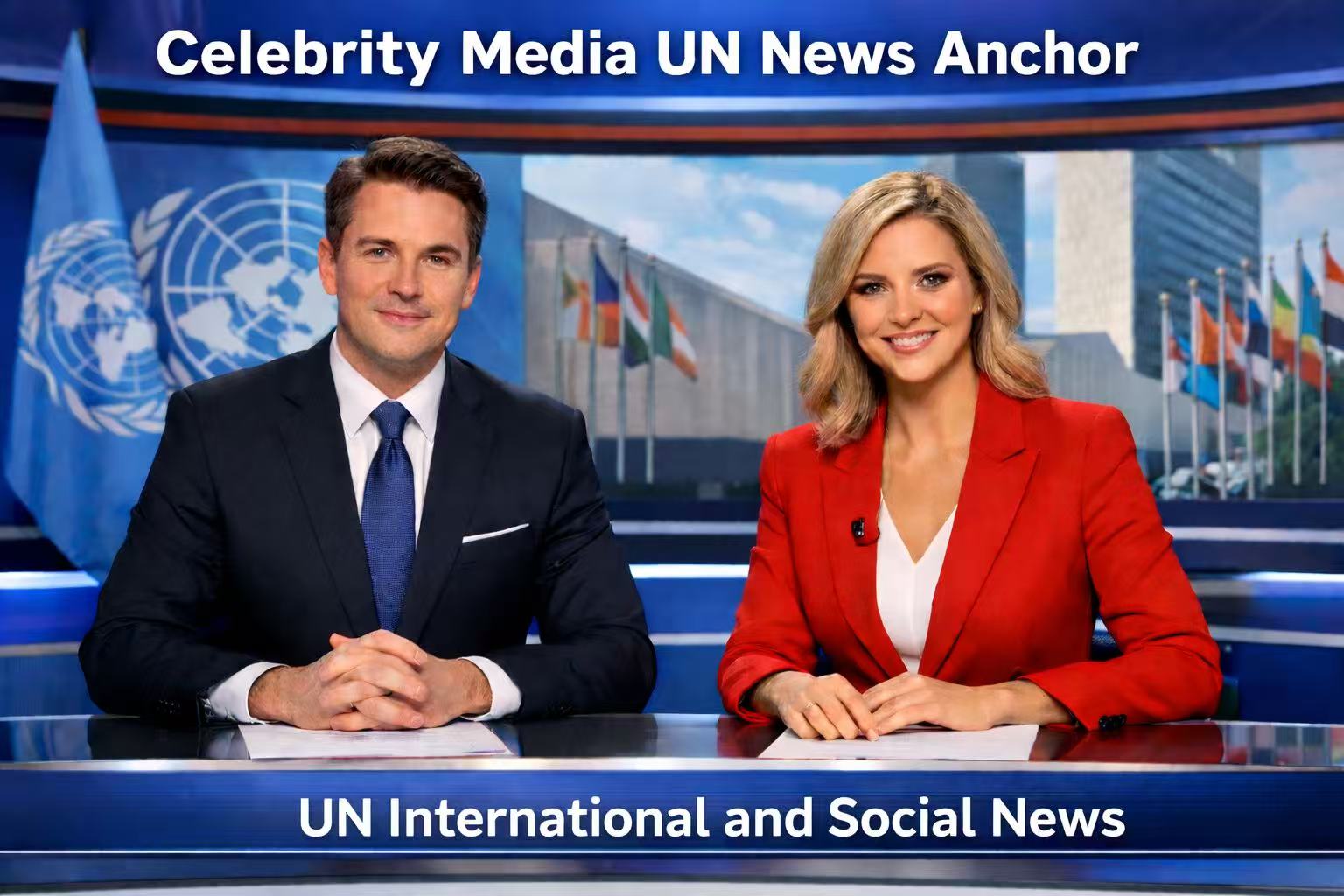
Celebrity Media Male Anchor New Year Greeting
Celebrity Media Female Anchor New Year Greeting

For a long time, the United Nations has played an irreplaceable role in international coordination and authoritative information dissemination through its mature and stable official communication system. At the same time, with the development of mobile internet and artificial intelligence technologies, the ways in which the public accesses information have changed significantly: faster dissemination rhythms, more diversified media formats, and highly fragmented language environments. Within this reality, how to further enhance the global accessibility and comprehensibility of international public information—while respecting existing institutional publication systems—has gradually become a noteworthy direction in communication practice.

It is against this backdrop that Celebrity Media, drawing on years of participation in international news gathering and editing, has launched a new generation of independently developed news publishing systems. With multilingual coordinated release and cross-platform presentation as its core design orientation, the system explores centralized content presentation within a single page, covering both desktop and mobile use scenarios, and supporting synchronized publication of landscape and portrait content, thereby building a multidimensional communication structure integrating video, audio, and rich text.

From practical application perspectives, the system treats mobile dissemination as a key entry point, enabling news content to adapt more efficiently to different regions, devices, and language environments. United Nations meetings, international organization activities, public welfare initiatives, and cultural exchange content can be produced and published using on-site video or audio materials, and flexibly distributed across multiple international communication platforms according to dissemination needs, forming a multi-platform coordinated dissemination pathway.

Celebrity Media

Second Floor Diplomatic Lounge at the United Nations: A “World Museum” Formed by the Great Wall Tapestry and Art Gallery

The year 2025 marks an important milestone—the 80th anniversary of the founding of the United Nations. Public discussions surrounding peace, development, and global governance have continued to intensify. As an international media organization focused on United Nations news and international affairs, Celebrity Media Foundation (CMF) has gradually refined its six-language international news publishing system during this period. The system supports simultaneous publication in Chinese, English, French, Russian, Spanish, and Arabic, and in certain cases expands into additional languages as needed, aiming to enhance synchronized visibility of international public issues across different language regions.

The operation of this system is not a simple technological overlay, but rather the formation of a relatively mature working mechanism across editorial workflows, role allocation, and content transformation. Through unified multilingual editorial templates and collaborative division of labor, copy editors, multimedia editors, and technical teams each fulfill their respective roles, enabling content production to maintain consistency while remaining scalable. This process-standardized news production approach provides practical support for multilingual, high-frequency international news publishing.

From the perspective of communication practice, the significance of six-language simultaneous publication lies not in numerical coverage itself, but in providing a more balanced linguistic access pathway for international public issues. In the global communication environment, language differences often directly affect whether information is seen and understood. Multilingual coordinated publishing allows issues to enter public discussion spaces across different language regions simultaneously, creating greater possibilities for cross-cultural understanding.

On this basis, Celebrity Media’s news publishing system has gradually demonstrated characteristics that transcend the value of use by a single institution. It does not serve a specific market or a single group, but rather targets international public issues, public welfare organizations, and transnational audiences, providing relatively stable and replicable dissemination support. Any information related to peace, human rights, gender equality, and sustainable development has the opportunity to gain equal presentation channels within this system.

From a broader perspective, when communication technologies are no longer merely tools for content distribution but become infrastructure connecting different languages, cultures, and publics, their public nature begins to stand out. Celebrity Media’s exploration in this direction reflects a practical pathway for civil media participation in international public communication: not replacing existing systems, but expanding ways for public information to enter global society beyond established frameworks.

For a long time, CMF has consistently focused on core United Nations mission areas such as poverty alleviation, gender equality, educational development, peacebuilding, and cultural exchange. The foundation firmly believes that global communication should not be constrained by language, and that important information closely related to international public affairs should be equitably accessible to audiences across different countries and cultural backgrounds. For this reason, CMF strives to transform media functions into a long-term driving force for global public interests through continuously refined professional editorial systems and multilingual dissemination capabilities. As emphasized in the foundation’s internal consensus: “Media are not only disseminators of information, but also participants in global public dialogue and drivers of social responsibility.”

Looking ahead, Celebrity Media Foundation will continue to deepen its practice in international news gathering and editing, public issue communication, and multilingual technology applications, while maintaining open collaboration with relevant United Nations bodies, international organizations, and public welfare partners. As the international communication environment continues to evolve, how to connect the world and promote understanding in a more inclusive manner will become a shared challenge for all participants in public communication.

At the historic milestone of the United Nations’ 80th anniversary, communication concerns not only the flow of information, but also how global society understands one another and looks toward the future. The exploration of Celebrity Media’s news publishing system serves as a practical annotation of “international communication as a public asset” within this context.

UN chief urges world leaders to ‘get priorities straight’ as New Year message calls for peace over war

Children in Gaza celebrate the announcement of a ceasefire in October 2025.

© UNICEF/Eyad El Baba Children in Gaza celebrate the announcement of a ceasefire in October 2025.


As the world enters 2026 amid mounting crises, the UN Secretary-General António Guterres has issued a stark but hopeful New Year appeal, urging global leaders to shift resources away from destruction and towards development, peace and people.

“The world stands at a crossroads,” he said, warning that conflict, climate breakdown and systemic violations of international law are eroding trust in leadership worldwide.

“People everywhere are asking: Are leaders even listening? Are they ready to act?” he said.

Mr. Guterres underscored the scale of global suffering, noting that more than a quarter of humanity now lives in conflict-affected areas. Over 200 million people require humanitarian assistance, while nearly 120 million have been forcibly displaced by war, crises, disasters or persecution.

Against this backdrop, he pointed to what he described as a profound imbalance in global priorities.

“As we turn the page on a turbulent year, one fact speaks louder than words: global military spending has soared to $2.7 trillion,” he said, nearly 10 per cent higher than the pervious year.

That figure, he stressed, is 13 times higher than total global development aid and equivalent to the entire gross domestic product (GDP) of the African continent. If current trends continue, military spending could more than double to $6.6 trillion by 2035, even as humanitarian needs continue to rise.

A path to hope

Despite the grim statistics, the Secretary-General underscored that solutions are within reach.

In September 2025, he launched the report The Security We Need: Rebalancing Military Spending for a Sustainable and Peaceful Future. The report shows how relatively small shifts in spending could deliver transformative results.

Less than four per cent of current military expenditure could end world hunger by 2030, it finds, while just over 10 per cent could fully vaccinate every child. Redirecting 15 per cent would more than cover the annual cost of climate adaptation in developing countries.

 “It’s clear the world has the resources to lift lives, heal the planet, and secure a future of peace and justice,” Mr. Guterres said.

Call to action

Looking ahead, he had a direct message to leaders globally.

“On this New Year, let’s resolve to get our priorities straight. A safer world begins by investing more in fighting poverty and less in fighting wars. Peace must prevail,” he urged.

Addressing people everywhere, he added: “Play your part. Our future depends on our collective courage to act.”

“In 2026,” he concluded, “I call on leaders everywhere: Get serious. Choose people and planet over pain. Let’s rise together – for justice, for humanity, for peace.”

UN Secretary-General António Guterres addresses the Fifth Committee: Revised Budget for the United Nations 80th Anniversary

Six-language simultaneous mode · UN News Highlights
中文 · العربية · English · Français · Русский · Español


UN celebrates 10 years of progress in youth, peace and security agenda

Young leaders take part in a Peace Circle at UNHQ (file Dec 2025)UN News/ Conor Lennon Young leaders take part in a Peace Circle at UNHQ (file Dec 2025)

By Conor Lennon

The UN has long been at the forefront of efforts to involve young people in decision-making, and the last decade has seen significant progress, thanks to the adoption of a Security Council resolution on youth, peace and security which led to widespread changes in the ways that the voices of young people are not just heard, but also incorporated in peace plans and policies.

In 2021, after the Taliban takeover, Nila Ibrahimi and her family fled Afghanistan. Having been a vocal rights advocate since the age of thirteen, when she led a viral campaign that successfully overturned a government ban preventing Afghan girls over the age of 12 from singing in public, she knew that she risked being a target of the new regime.

Portrait of Nila Ibrahimi standing outdoors with a snowy landscape and blue sky in the background.UN Youth Office

After spending time in hiding, she now lives in Canada, but she hasn’t left activism behind. From her new home, she started HerStory, an organisation dedicated to documenting the experiences of girls both inside Afghanistan and across the diaspora.

“I do my best to tell the stories of girls who have been banned from going to school. I was able to graduate but my friends are still stuck in time in the ninth grade. It’s emotional work, but I think that if it motivates just one person to do something, then I think that I have done enough”.

Active partners in peace

Ms. Ibrahimi was speaking to UN News at an event held on 15 December to mark the tenth anniversary of Security Council Resolution 2250, which formally recognises young people as active partners in maintaining and promoting international peace and security.

Around half the people on the planet are under 30, which makes them the generation with the greatest stake in our common future. Nevertheless, they are often excluded from the spaces where solutions to our most intractable issues are shaped.

Since the adoption of the resolution, the UN has supported a host of initiatives implementing the recommendations it contains. For example, the Democratic Republic of the Congo, The Gambia, and Honduras developed Youth, Peace & Security (YPS) national and local action plans; the African Union held Africa’s first continent-wide dialogue on YPS, culminating in the Bujumbura Declaration; and 11 countries, from Africa to the Middle East, Asia and Europe, have so far enacted YPS action plans that are aligned with Resolution 2250.

Afghanistan, still ruled by the Taliban, is not one of them. However, Ms. Ibrahimi, who has often felt that she is ploughing a lonely furrow, remains undaunted and dedicated to continuing the fight for women’s rights.

“It really struck me, in the conference, that I'm in the same room as some people who I would never have had the opportunity to meet and learn about the ways that they have implemented strategies to empower youth in their countries,” she reflects. “Just being in their presence has been a big privilege and opportunity to not just talk about my own story and raise the voices of Afghan women but also learn from others”.

Act now for peace

The 15 December events culminated in a Peace Circle, featuring Ms. Ibrahimi, several other young leaders, and senior UN officials, diplomats and academics. Peace Circles grew out of a major UN initiative, as part of the flagship Act Now campaign. They are informal dialogues on subjects connected to peace, which could range from subjects as wide-ranging as education gender equality, climate and technology. At least half of the participants have to be under 30, with an emphasis on young people who are often not at the table and new to UN spaces.

The Act Now for Peace campaign runs until September 2026, and the discussions held at the Peace Circles will directly feed into a number of UN projects, including the UN Secretary-General’s Independent Study on youth contributions to peace, and a Global Youth Peace Manifesto.

The Return of Public Faith: Why Pastor Lenny Cheng Has Become a Driver of Our Time

Celebrity Media Commentator: Within the generally gentle, cautious, and controversy-avoiding cultural atmosphere of Chinese churches, Pastor Zheng Lixin and the “Trumpeter Ministry” he founded stood out as both strikingly unconventional and urgently necessary five years ago. He dares to confront the deep structural tensions between culture and politics, dares to point out the real dilemmas faith faces in contemporary society, and dares to call believers to assume public responsibility rather than locking faith away in a private spiritual corner. Such a voice has long been extremely rare in the Chinese world, yet the times are proving that it is precisely this kind of voice that is most forward-looking and most constructive.

The current U.S. administration’s renewed affirmation of Christian culture is a clear example. Since President Trump assumed office once again this year, American political culture has undergone a rare reversal—public faith is no longer treated as an “untouchable forbidden zone,” but is being reconsidered as a key factor in sustaining the nation’s moral center. Acting U.S. Secretary of Defense Christopher C. Hergerthes openly raised his hands to lead prayer at the Pentagon, calling military officers and civilian officials to lift up the name of Jesus at the very heart of national military power. The Pentagon is not a church; it is the strategic and command center of the U.S. military. The appearance of such a scene signals a recalibration of cultural direction. Even more historically significant, on September 8, 2025, during a speech at the Museum of the Bible in Washington, President Trump once again publicly declared: “We are a nation under God, and we always will be.” In contemporary American political culture, this was not an ordinary statement, but a public reaffirmation of values—a pushback against more than a decade of faith being forced out of the public sphere.

The Return of Public Faith: Why Pastor Lenny Cheng Has Become a Driver of Our Time

For many years, the core emphasis of Zheng Lixin’s Trumpeter Ministry—that “faith must return to the center of public life”—has formed a profound resonance with this national-level cultural return. Pastor Zheng’s sharp edge lies not merely in his willingness to speak, but in his courage to identify who dares not speak. His critique is directed not at society, but at the church’s silence in the face of the times. He has long warned that if Christians continue to confine faith to personal devotion and church activities, while lacking cultural analysis and public responsibility, the next generation will inevitably be shaped by the mainstream education system, social media, and secular culture. If families do not act proactively, culture inevitably will; if the church remains silent, values will inevitably be defined by others. These words may be uncomfortable, but they accurately expose a long-standing blind spot within Chinese churches.

The prayers at the Pentagon and the public declaration at the Museum of the Bible have generated enormous social reaction precisely because they broke the taboos imposed by political correctness in recent years. Supporters argue that the United States was founded on trust in God and biblical values, and that without a foundation of faith, social order cannot be sustained, family structures will continue to collapse, and society will struggle to withstand the shock of value confusion. Critics, by contrast, loudly accuse the government of “religious interference in politics,” claiming that such public prayer deepens social division, with some media outlets even attempting to downplay the significance of the events themselves. Yet the fiercer the controversy, the clearer one fact becomes: America is contesting its cultural soul, and that contest will never be won through silence.

This is precisely where the significance of the Trumpeter Ministry lies. It does not seek to manufacture religious emotion, but to rebuild a language of public faith—enabling Christians to understand the contours of contemporary culture, to re-establish faith transmission within families, and to speak in the public sphere with maturity and rationality. What Pastor Zheng proposes is a systematic project of cultural reconstruction: from parents to churches, from education to values, from private belief to public responsibility. He continually reminds believers that faith without a public dimension cannot influence society; faith confined to Sundays cannot shape the next generation; faith that never enters the cultural core can only be submerged by the tides of the age.

The prayers at the Pentagon, and President Trump’s public declaration at the Museum of the Bible “We are a nation under God, and we always will be,” represent a real-world response to the core vision of the Trumpeter Ministry. They demonstrate that faith has not withdrawn from the national stage; rather, after a prolonged cultural vacuum, it is once again being regarded as a foundation for social stability. For Chinese churches, this serves as a sobering wake-up call. Silence is not neutrality—it is withdrawal from the battlefield; avoiding controversy is not wisdom—it is abdication of responsibility. Without proactive preparation, the next generation will inevitably lose its way amid value conflicts.

In this sense, Pastor Zheng Lixin is not merely a commentator on the times, but a driver of the times. What he advances is not a surge of religious emotion, but a long-term reconstruction of cultural foundations, a reshaping of values, and a proactive stance against overwhelming cultural currents. As national-level discourse once again speaks of being “under God,” and as faith re-enters the public center, the trumpet blast of the Trumpeter Ministry becomes both a prelude and a footnote to this historic shift.

What Pastor Zheng Lixin is doing is ensuring that Christians are no longer absent from the cultural battlefield. In the reconstruction of civilization, a single trumpeter often matters more than a thousand who remain silent.